Solar Water Heating: Turning Renewable Energy into Reliable Hot Water
Type / to choose a block
Introduction
Energy costs, energy independence and system reliability have become major concerns for the European heating market. As a result, manufacturers and building owners are increasingly looking for solutions that make better use of renewable energy while maintaining comfort and safety.
In this context, our customer’s challenge was to maximize the use of free solar energy, avoid nuisance tripping during periods of high solar input, and activate auxiliary heating only when necessary.
Market trends
Recent volatility in oil and gas prices is accelerating the search for heating solutions that reduce dependence on fossil fuels. At the same time, renewable heating technologies are gaining momentum across Europe. Heat pumps are expanding rapidly, while solar thermal remains another relevant solution for producing domestic hot water using renewable energy.
The objective is increasingly clear: use renewable energy whenever available, while maintaining comfort, reliability and safety. To address these challenges effectively, it is essential to understand how solar energy is collected, stored and supplemented when necessary.
How Does Solar Water Thermosiphon Work?
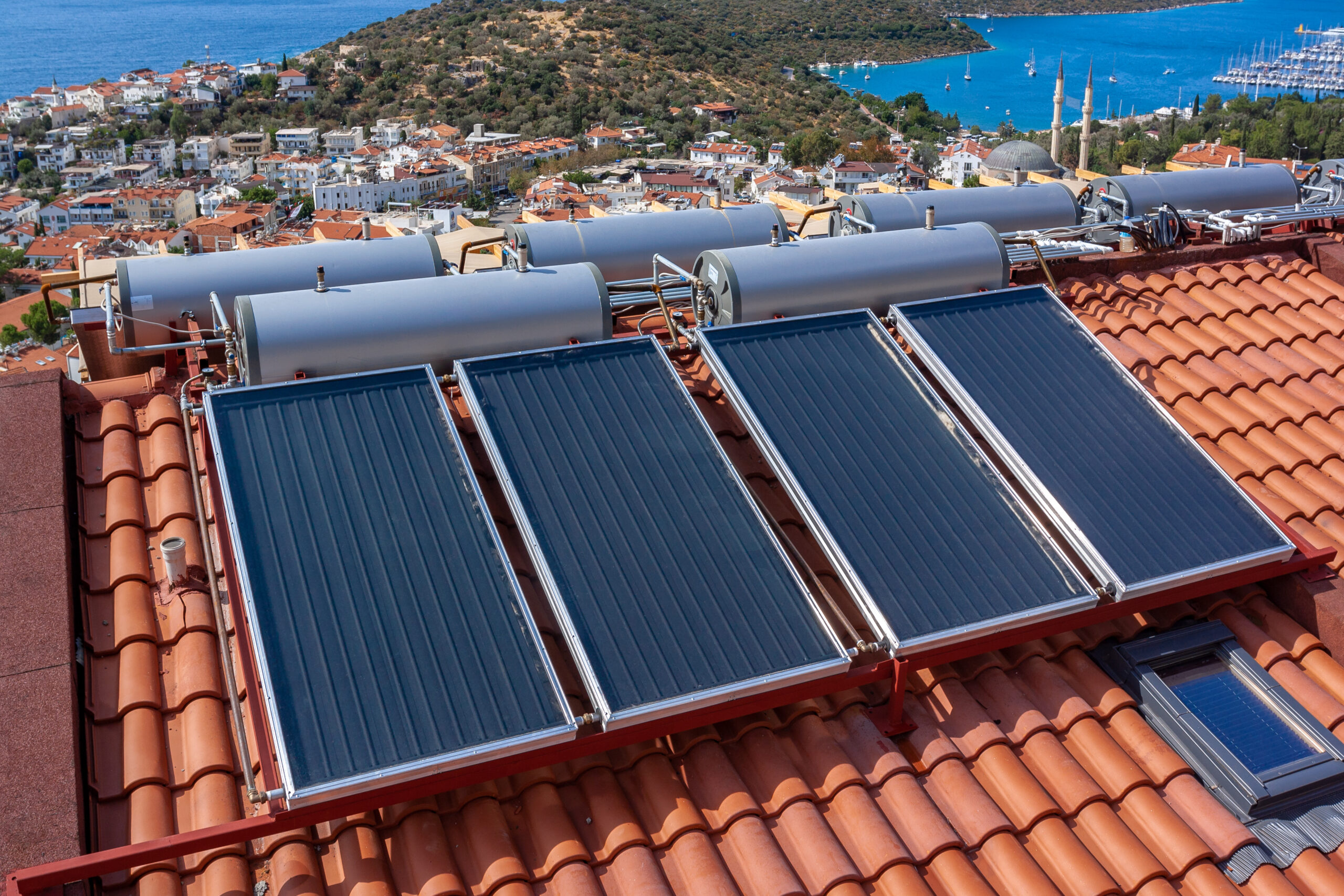
Solar thermal collectors capture energy from sunlight and transfer this heat through a heat exchanger to water stored inside a hot-water tank. This water storage tank aims to accumulate and manage the difference temperature between heating and usage. The collector surface area and tank size depend on the need and the amount of sunlight.
The system does not include any pumping system. Water circulation occurs solely through a thermodynamic phenomenon known as thermosiphon .
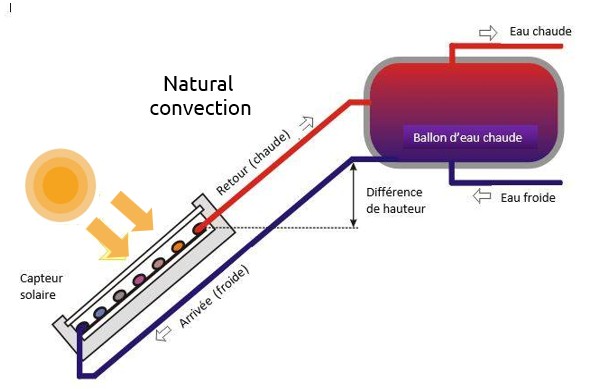
The principle of the thermosiphon system is that cold water has a higher density than hot water because it is more compact. It is therefore heavier and sinks. However, every system tends towards a state of thermodynamic equilibrium. A movement called thermal convection therefore occurs to mix the hot and cold water.
This is why the solar collector is always mounted below the water storage tank, so that cold water from the tank flows to the collector via a downpipe. As the water heats up in the collector, the hot water naturally rises, pushed by the cold water, and returns to the tank. This tank-pipe-collector cycle heats the water until it reaches an equilibrium temperature. The consumer can then use the hot water from the top of the tank.
When sufficient solar energy is available, this system can cover a significant part of the hot-water demand without relying on conventional heating sources. However, solar availability naturally varies according to weather conditions, season and hot-water consumption (low or high usage). For this reason, many solar storage systems integrate an electric backup heating element to maintain the required water temperature whenever solar energy alone is insufficient.
Reliable thermal control therefore becomes essential to:
- maintain the required water temperature,
- control the auxiliary electric heating element,
- avoid unnecessary energy consumption,
- protect the system against overheating,
- ensure consistent hot-water availability.
Backup Solution from Cotherm
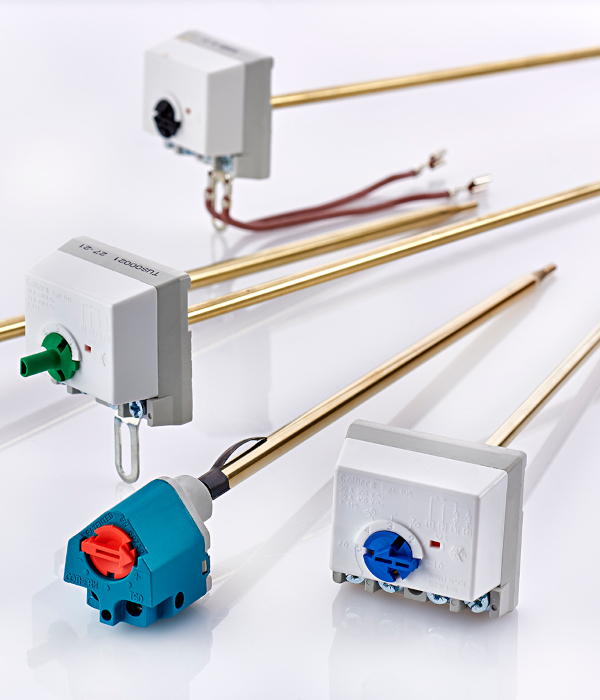
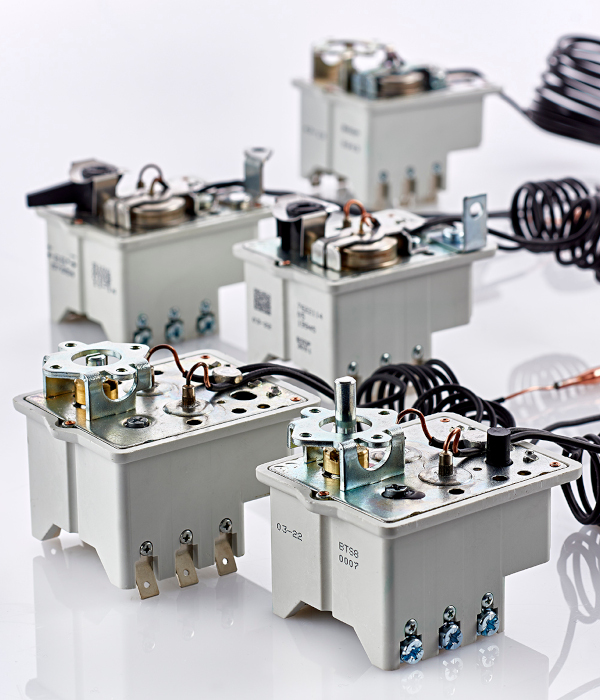
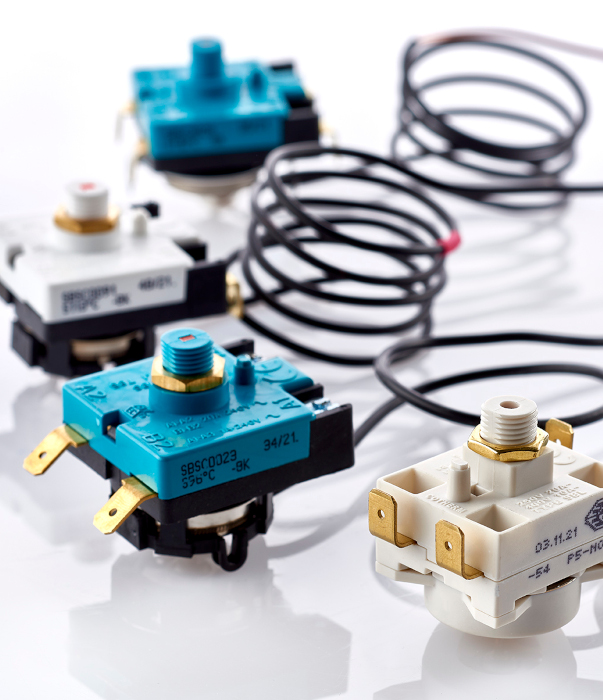
Cotherm thermal-control solutions can be integrated into solar hot-water storage systems to manage the electric backup heater. Cotherm TUS thermostat solution can address 2 needs simultaneously. It can be used as a control regulation and safety at the same time.
Key numbers:
- Regulation temperature range: 65°C
- Safety temperature range: 115°C
- Project quantities: 300,000 annually
- Project time : completed in 6 months
Projects key steps :
- Defined target level of comfort
- Safety control simulation of tank design at high temperature
- Preset TUS thermostat based on CFD (Computational Fluid Dynamics)
- Select the set of water heaters for testing and test on field
- Start the Mass production process

The thermostat monitors the water temperature and controls the heating element when additional energy is required, while an integrated safety function protects the system against abnormal overheating.
The safety temperature is set high to prevent safety shutdown during normal operation. Taken into consideration that the water in the tank can reach up to +115°C.
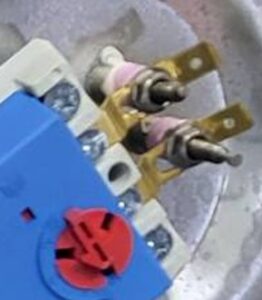
Cotherm wired plug-in thermostats, known as TUS can therefore provide manufacturers with a compact solution combining temperature regulation, safety and easy integration with immersion heating elements with direct screw mounting on heating element (as shown in the picture below)
For manufacturers developing solar water heaters, renewable-energy storage tanks or hybrid water-heating systems, Cotherm provides thermal-control solutions designed to combine energy efficiency, safety and reliable hot-water comfort.